Article
3 questions for Arthur Muller, co-founder and CPO of Explain
Arthur Muller, co-founder and CPO of Explain, explains how his team built an AI agent that is an expert in public procurement. The best of both worlds: the power of the latest AI model plus tender expertise. The result: writing time cut by 3.
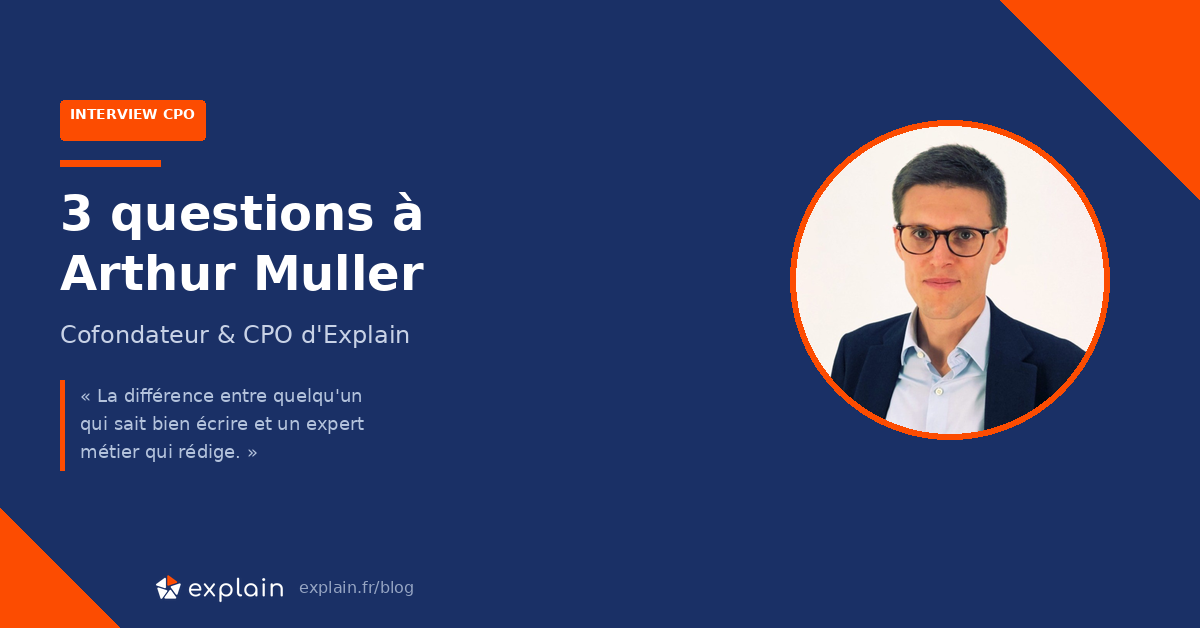
Arthur Muller, co-founder and Chief Product Officer of Explain, lifts the hood and explains how his team built an AI agent that is an expert in public procurement, and why this technology can finally transform tender responses.
People often say you just need to plug ChatGPT or Claude into your documents to write technical proposals. Is that true?
Partly. These models are remarkably powerful, and any AI product has to build on them. Today, Explain's base technology layer is Claude, because it is currently the best performing model on the market. As soon as a new version comes out, our users benefit from it automatically.
But we designed Explain so that our users get the best of both worlds: the power of the latest AI model plus tender expertise.
What Explain has built is what changes everything: business expertise in public procurement. Our engineers have built dozens of agents specialised in the tasks specific to writing technical proposals. In France, these agents know the 1,798 articles of the Public Procurement Code. They know what technical specifications, a mandatory response framework or a European Single Procurement Document are. They know how to write to gain points on a technical score, and how not to lose them. A general-purpose LLM will produce something plausible. Fluent, even. But it will not have the right tone, the right structure or the right content to meet a public buyer's real expectations.
The difference is the one between a business expert and a bright intern who has just arrived. The intern may get by; the expert knows what is really at stake.
In practice, what does it change for a team responding to tenders?
Two things: quality, then time saved.
On quality: Explain is designed to produce proposals that are both 100% compliant with the specifications, because it reads every tender document in full without missing anything, and 100% tailored to your company, because it relies on your own documents: your past proposals, your brochure, your CVs, your references. This is not an AI that generates generic text. It is your agent, writing as if it were your best colleague, the one who knows both the tender and your company inside out.
We taught our agents the best practices of tender responses, the rules of the trade. There are quality standards and safeguards at every step. The tool refuses to write until it has carried out an in-depth analysis of the tender documents. It detects whether your internal documents are too thin or unsuited to the target contract. It can spot an inconsistency between the technical specifications and an appendix, a deadline mismatch or award criteria that have not been properly addressed, and alert you before you submit. It proofreads itself before submitting. That level of professional rigour is something you cannot get by using ChatGPT or Claude directly.
On time saved: our users cut their writing time by two or three on average. A tester told us recently that a routine tender that used to take him two days now takes him two hours, proofreading included. And at Explain, we respond to tenders with our own tool. On our latest response, the person in charge did not write a single line herself; she reread and amended some passages, but the writing was done.
Explain works with SMEs, but also with large groups that have their own technical departments. Why do they choose an external tool?
Because what we have built is not trivial to reproduce: you need to know both AI and public procurement very well, and spend a lot of time making everything work properly. Behind Explain, there is a team of AI engineers who have spent months benchmarking the available models, building the right agents and evaluating outputs on hundreds of real proposals, to understand where LLMs go off the rails and how to correct them. That iteration work is not something you improvise in a few weeks.
What also reassures these large accounts is our positioning: we are not a wrapper around Claude dressed up as a product. We are infrastructure designed for public procurement, with a technical layer that deepens with every update, and business expertise built over four years of working alongside bid teams, public law specialists and tender managers. This is not an abstract conviction; it shows in our customers' win rates, large groups as well as SMEs and mid-sized companies, who face the same challenges.
This is a pivotal year. Those who do not equip themselves today will not be ahead tomorrow: they will be behind. The question is no longer whether AI will transform public tender responses. It already is. Explain lets you benefit from the tremendous time savings of the latest generation of AI, while guaranteeing a high level of expertise and reliability.