Article
One month of confidence, three months of reality: what teams experience when they test generative AI on their tenders alone
"We can already do that with Claude or ChatGPT." The phrase comes up often in meetings, and it is often true in the first month. What teams that push further go through, and why the issue was never access to a language model.
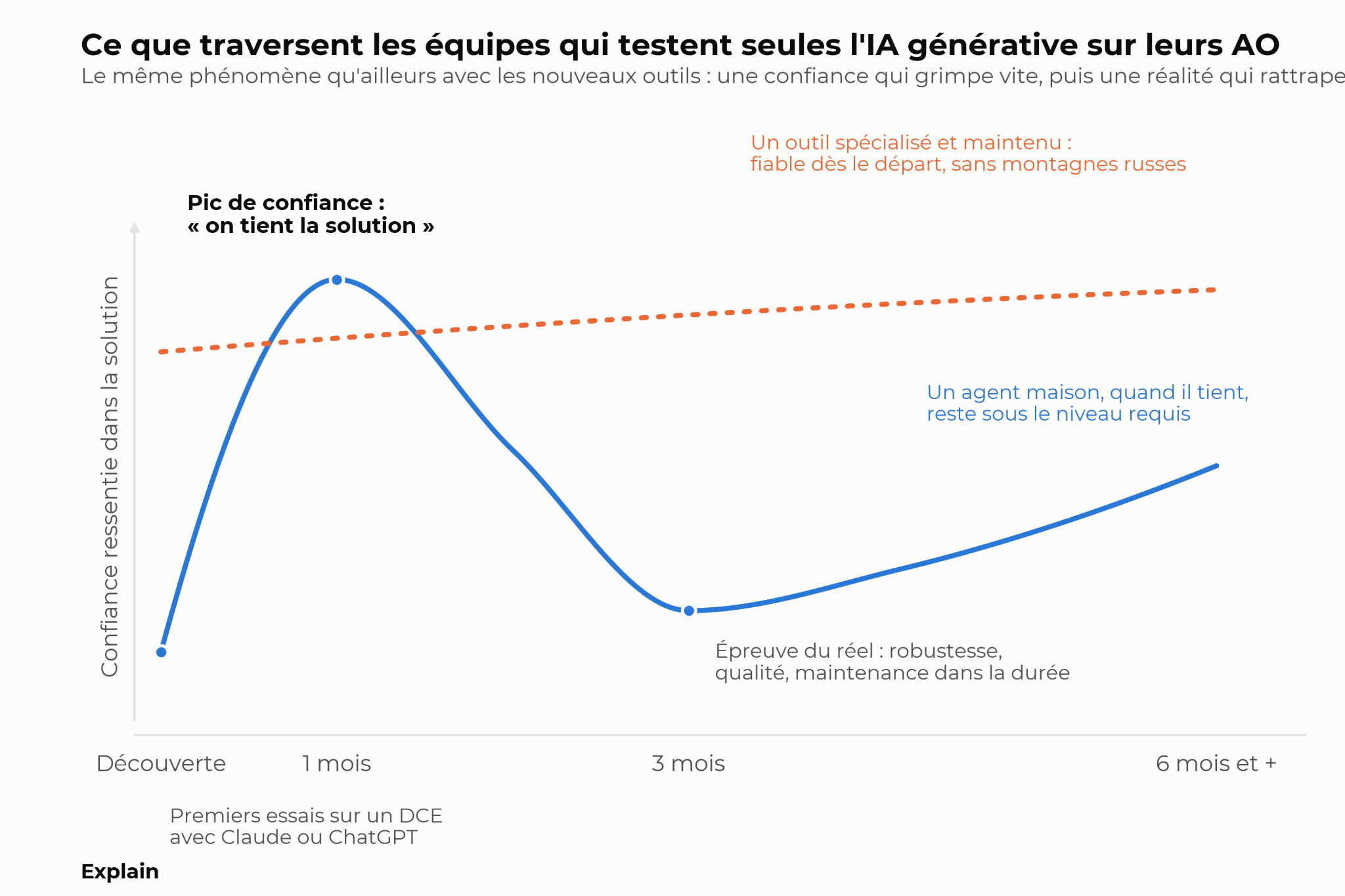
There is a moment that comes up often in meetings. We present Explain to a branch director, the head of a bid unit, a project officer who has been responding to public tenders for years. And at some point in the conversation, the same sentence comes: "We can already do that with Claude or ChatGPT."
It is not a lie, nor bad faith. It is often even true, on one specific point: pasting an extract of the specifications into a general-purpose AI and getting a decent technical proposal outline out of it is something any curious project officer can do today. The problem is not there, but in what happens in the following months.
The month when everything seems possible
The scenario is almost always the same: the person tests it, gets a surprisingly good result on one file, and within a month feels able to go much further. They feel they have found a solution that neither their management nor their competitors have spotted yet. Ambition grows fast: building in-house agents able to monitor tender publications, automatically analyse tender documents, help with response strategy, then write and proofread the bid.
This pattern is not specific to tenders, or even to AI. Gartner calls it the move from the "peak of inflated expectations" to the "trough of disillusionment", and placed generative AI in that very trough in its 2025 Hype Cycle. An MIT study published in August 2025, covering 300 enterprise deployments, points the same way: 95% of generative AI projects produce no measurable impact on results, even as individual use of tools such as ChatGPT or Claude explodes, because it is immediate and flexible. Confidence climbs very quickly, driven by early individual results. It then falls about as fast as it rose, as soon as the aim is to turn it into a reliable process.
What the third month reveals
In teams that really push the subject beyond the first month, three difficulties come up almost systematically, whatever type of contract they work on.
The first is the difficulty of building robust agents alone. A prompt that works once on one file does not necessarily work on the next. Making an agent reliable means structuring data, anticipating edge cases, testing on dozens of real files and fixing what fails. It is long-term engineering work, not a weekend tweak, even for teams with real technical skills.
The second is the difficulty of reaching a satisfactory level of quality, and keeping it consistent. An agent that produces a good result one day can produce a mediocre one the next, on a comparable file, without anyone always understanding why. This instability makes any industrialisation impossible: you cannot build a reliable sales process on a tool whose quality varies from one file to the next.
The third is the difficulty of maintaining the agent over time. Models evolve, tender document formats too, and the team's needs change. Without continuous maintenance and R&D, quality degrades within weeks. That is the hidden cost: the time that was supposed to be freed up to respond to more tenders, or spend more time with prospects, is actually spent maintaining the tool, not selling more.
What it changes in the way you sell
On tenders, the fall that follows the peak of confidence has a direct cost: less well prepared files, lost sales time, sometimes bids not submitted on time.
What our customers in water, public works, transport, energy and professional services tell us, once they have been through this phase, is that the issue was never access to a language model. Everyone has access, Claude and ChatGPT included, for free or almost. The issue is what lies between the model and the submitted proposal: knowledge of sector vocabulary, the structure of technical specifications, the logic of a scoring grid, thousands of tender documents and proposals already analysed to calibrate each response. That is the work that takes time to build, must be maintained continuously, and cannot be done on the side of a sales job or an already full bid unit.
Finally, there is a simpler question to ask. Your teams probably have the skills to build, given time, something that holds up. But their job is to win contracts, not to design AI agents. Ours is: it is the only thing we do, talking every week with bid units in every sector, all over France. The question is not whether your teams could get there one day. It is who is most likely to get there first, and keep it at that level over time.
Sources: Gartner, Hype Cycle for Generative AI, 2025 (July 2025); MIT NANDA, The GenAI Divide: State of AI in Business 2025 (August 2025); TechCrunch and Fortune, reporting on Uber's AI budget overrun (May-June 2026).